A storm damage roof replacement inspection is the document that decides what your insurance pays. Florida carriers have tightened policies in the last five years. Roof age, deductible structure, and depreciation math now determine whether your claim covers a full replacement or a fraction of one.
This is what 30 years of standing next to Miami homeowners during adjuster meetings looks like, distilled. The pre-storm photo file. The named storm deductible math. The five-step documentation walk. The mistakes that have cost neighbors of yours the coverage they paid premiums on for a decade. None of this is legal advice. All of it is field experience.
A storm damage roof replacement inspection done correctly the first time saves homeowners money. Done wrong, it costs them their claim. The difference is documentation and timing.
Before You Pick Up the Phone, Pick Up Your Camera
The 30-Minute Window Most Homeowners Miss
The 30 minutes after conditions clear and before the wind dies completely is when raw damage is most visible. Wet tiles still show their displacement. Lifted shingles have not reseated. Soffit panels still hang at the angle wind left them.
Photograph everything before nature settles the scene. Get every elevation from the ground. Capture the gutters, the fascia, the visible roof field, and every penetration. Time-stamped phone photos carry geo-tags. Use them.
Why Insurance Companies Win Disputes on Photo Evidence
Build a Pre-Storm Photo File Right Now
If you are reading this before June 1, you have time to do the single most valuable thing: photograph your roof in clear weather. Walk every elevation. Take wide shots and close-ups. Document every penetration, every flashing detail, every gutter run.
Save the photos to cloud storage with a date stamp. After a hurricane, the difference between “this was already like that” and “this is new damage” is your pre-storm file. Build it now.
What Florida Insurance Actually Covers After a Hurricane
Named Storm Deductible vs Standard Deductible
Florida policies carry two deductibles. The standard deductible ($1,000 to $5,000 in most policies) applies to regular claims. The named storm deductible activates whenever the National Hurricane Center names the system that hit you. Named storm deductibles run higher (2 to 10 percent of insured value).
On a $400,000 home, a 5 percent named storm deductible is $20,000 out of pocket before insurance pays a cent. Know your number before hurricane season opens.
ACV vs RCV: The Settlement Math
Actual Cash Value (ACV) pays the depreciated value of your roof at the time of loss. A 15-year-old shingle roof can settle at 40 percent of replacement cost. Replacement Cost Value (RCV) pays the full cost to replace the roof in two checks: an initial ACV payment plus recoverable depreciation released once work is documented as complete.
Which one applies to your policy is in the declarations page. Check before a storm. Many Florida carriers shifted to ACV-only on older roofs in the last three years. A roof depreciation insurance claim on an older roof can settle for less than half the replacement cost.
The Florida Roof-Age Squeeze
Homeowners insurance roof age limit Florida policies are getting tighter every year. Several major Florida carriers now refuse to renew policies on roofs older than 15 to 20 years. Others switch coverage to ACV-only above a roof-age threshold.
A 15-year-old roof that survived Andrew and Wilma can still be functional. Your insurer will treat it as a liability anyway in many cases. Florida insurance roof age policy language appears at renewal without warning. Check yours.
Step-by-Step: From Damage to Approval
Step 1: Document Exterior Damage From the Ground
Walk all four elevations of your home. Photograph wide shots from the curb and close-ups from as far back as you can get a clear view. Photograph the gutters, fascia, soffit, visible roof field, ridge line, and every penetration you can see.
Stay on the ground. No ladders. No climbing. Wet decking and adrenaline are how Miami homeowners get hurt every year. The crew handles anything above the eaves.
Step 2: Document Interior Damage
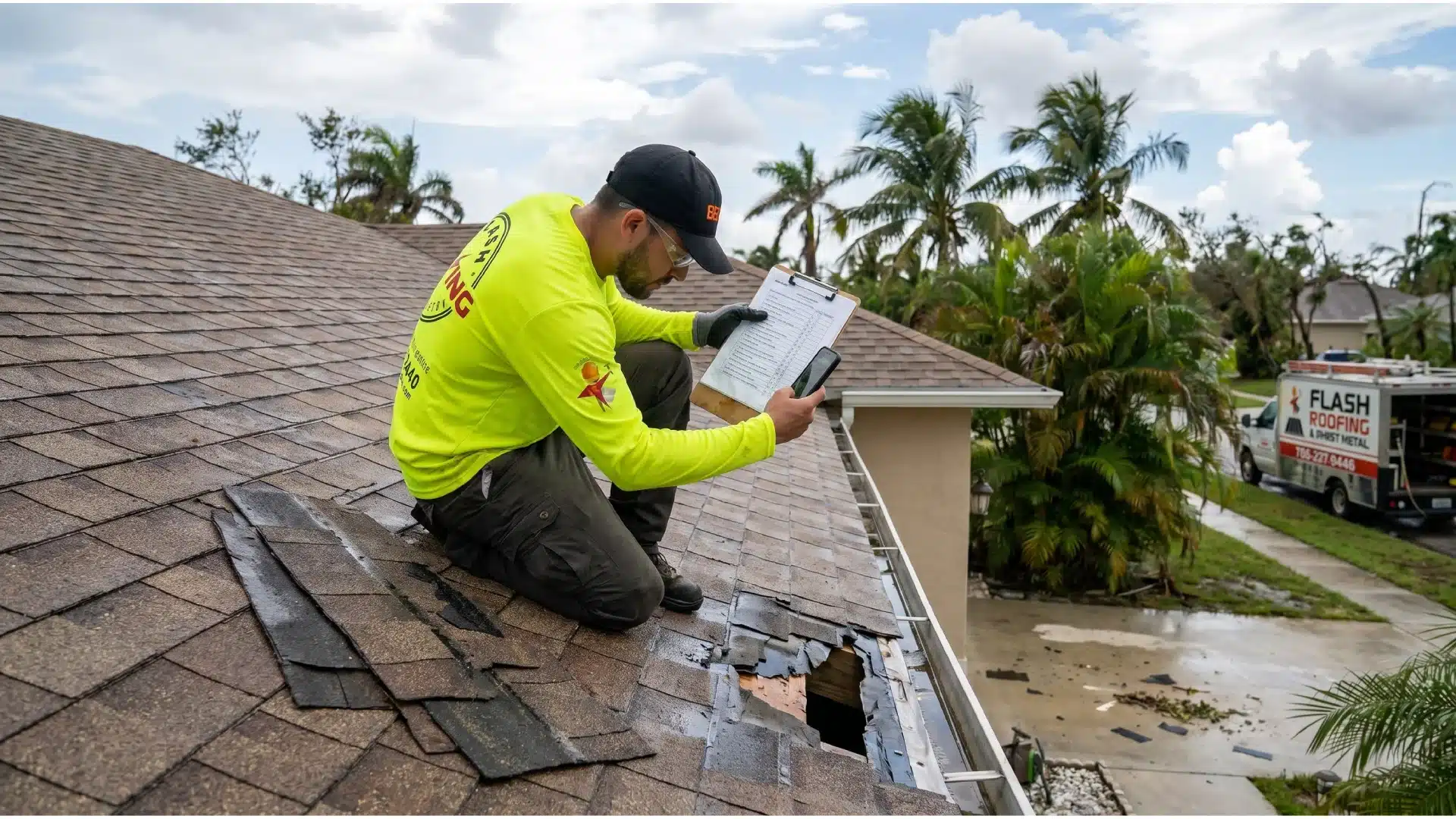
Walk every room and look up. Photograph ceiling stains, water marks, bulges, and any sagging drywall. Then go into the attic with a flashlight. Photograph the underside of the decking, any visible daylight, wet insulation, and stained rafters.
Interior photos connect the exterior damage to a functional failure. A roofer’s report references both. So does the adjuster’s settlement worksheet.
Step 3: File the Claim Within Florida's Window
Step 4: Get a Licensed Contractor's Scope of Loss
Step 5: Meet the Adjuster Prepared
Red Flags That Cost Miami Homeowners Their Claim
After every major Atlantic storm, the same scams roll through Miami-Dade. Three patterns repeat.
The Storm Chaser Adjuster
Out-of-state operators show up after every Cat 1 or stronger. They knock on doors offering free inspections and immediate paperwork. The paperwork transfers your insurance rights. They are gone before the claim closes.
A legitimate public adjuster Florida professional carries a state license, a permanent local office, and references from past clients. They are not the person who showed up at your door unannounced the morning after the storm.
Assignment of Benefits Without Reading
Assignment of Benefits (AOB) documents transfer your claim rights to a contractor. They were the center of a Florida insurance crisis that drove rates up across the state. Florida law tightened AOB rules in 2019 and again in 2023, but the practice continues.
Never sign an AOB at the first conversation. Read every line. If the contractor refuses to wait for a careful review, that is your answer.
Filing Too Early or Too Late
Public Adjusters and Attorneys: When to Bring Them In
A public adjuster Florida professional works for you, not the insurance company. An attorney works for you when the claim becomes litigation. Both have their place.
What a Public Adjuster Does That a Contractor Does Not
A public adjuster negotiates the claim. They review the policy, reinspect the damage, prepare a counter-estimate, and argue settlement terms with the carrier. A contractor (like us) produces the scope of loss but does not negotiate your coverage.
Florida caps public adjuster fees during a declared state of emergency at 10 percent of the claim for the first year. Outside that window, the standard cap is higher. The cap is in Florida statute.
When a Denied or Underpaid Claim Justifies Legal Help
A Local Roofer's Role in Your Insurance Process
We produce the storm damage roof replacement inspection report. We deliver the scope of loss to your adjuster. We coordinate the repair with the approval timeline. We do not become your adjuster.
Why Your Contractor Is Not Your Adjuster
The Scope of Loss Document Insurance Takes Seriously
Carriers know which Miami-Dade contractors produce scope of loss documents adjusters can trust. We have built that reputation through 30 years of named storm work. Our hurricane roof damage repair scope of loss tracks Xactimate pricing, follows HVHZ specifications, and uses dated photos as line-item evidence.
Coordinating Repairs Around Approval Timing
Permanent repair starts after claim approval. Temporary mitigation (emergency tarping) starts immediately. We coordinate the two so the home is protected while the paperwork moves and the permanent repair happens within the policy’s reasonable-time requirements.
Expert Insight
With over 30 years of storm damage roof replacement inspection work in Miami-Dade, the pattern after every named storm is the same. Homeowners with pre-storm photo files settle faster and higher. Homeowners with strong post-storm documentation rarely get denied. Homeowners who signed something they did not read in the first 48 hours spend the next year regretting it.
Andrew taught Florida that documentation matters. Irma taught Florida that documentation matters even more. Every claim we have walked through since 2017 has hinged on what the homeowner photographed and when. Build the pre-storm file now. Document the damage thoroughly when it happens. Read everything before you sign.
Does homeowners insurance cover roof damage from a hurricane in Florida?
How long do I have to file a hurricane damage claim in Miami-Dade?
What is the difference between ACV and RCV on a Florida roof claim?
Will my insurance pay for a full roof replacement after hurricane damage?
Should I hire a public adjuster for a Miami roof claim?
What documentation does my insurance company need for a roof claim?
Get the Documentation Right the First Time
A storm damage roof replacement inspection from a 30-year Miami-Dade crew is the foundation of a successful claim. We produce scope of loss documents adjusters recognize, photograph damage in formats insurers accept, and coordinate the timing so your repair starts the moment approval lands.
For hurricane roof repair in Miami-Dade and a documented post-storm inspection that supports your claim, call Flash Roofing at 786-237-9440. Licensed, insured, on Miami-Dade roofs since before Hurricane Andrew. 59 five-star Google reviews from homeowners we have walked through this same conversation. For legal or coverage advice, consult a Florida-licensed attorney or public adjuster.
Disclaimer: All pricing provided is for informational purposes only. Actual costs will vary based on specific project requirements and property conditions. Reach out to us for a free, personalized estimate.