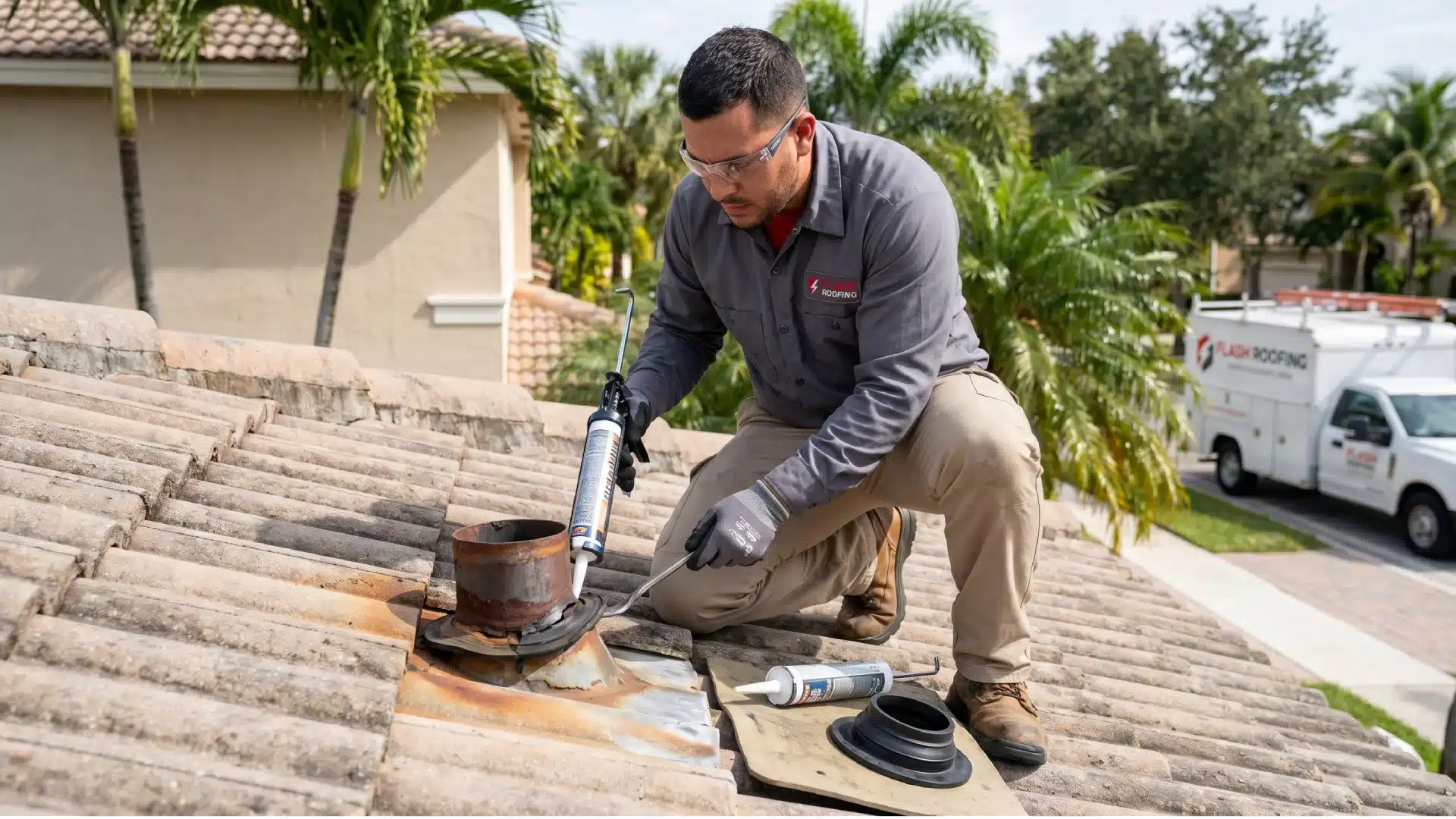
Roof flashing repair calls outnumber every other leak source we run in Miami-Dade. The flashing is the thin metal that seals every penetration and transition on your roof. When it fails, water enters. When it holds, the roof field can be 20 years old and still dry inside.This is what 30 years of cutting open Miami-Dade leak sources has taught us about flashing. The six types every roof has. Where flashing fails first. What repair costs in ranges. And the difference between a real roof flashing repair and a caulk smear that lasts six months.
What Roof Flashing Does and Why You Have Never Noticed It
The 6 Types of Flashing on Every Miami Roof
Step flashing seals the joints where a roof meets a vertical wall (dormers, side walls, chimney sides). Counter flashing tops the step pieces and tucks into the masonry above. Drip edge runs along the eaves and rakes to direct water off the deck. Valley flashing handles the runoff where two roof planes meet. Pipe and vent boots seal plumbing and attic vents. Headwall flashing handles the rare transitions where a lower roof meets an upper wall.
Six components. Six failure points. Each one with a different repair path.
Where Flashing Fails First
Why a $300 Repair Prevents a $5,000 Repair
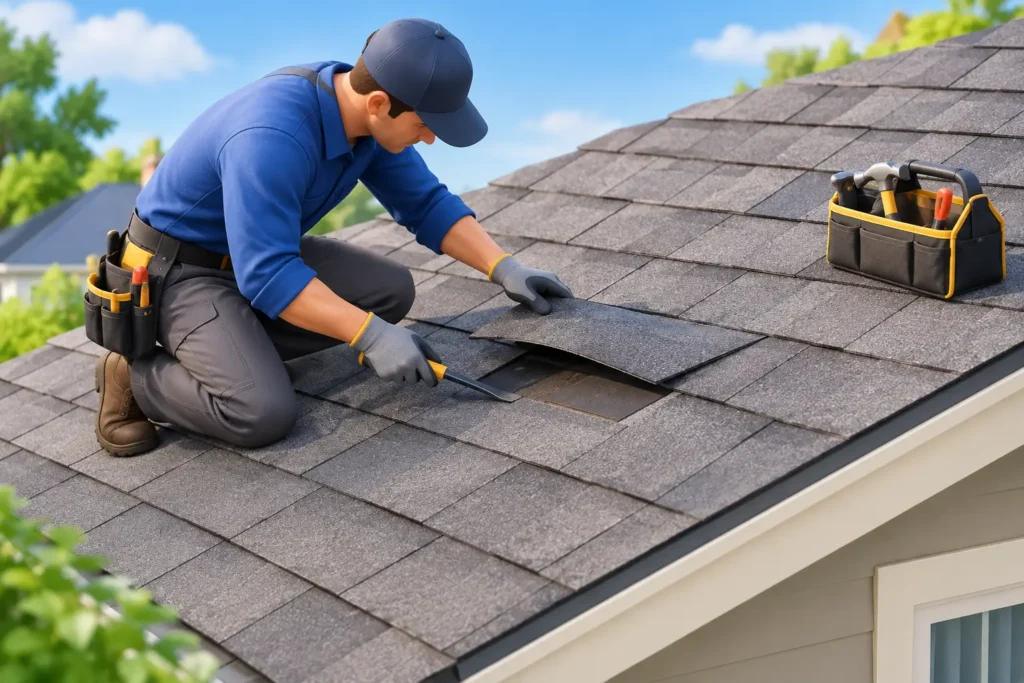
A small roof flashing repair caught early stays under three figures in many cases. The same leak left unaddressed for six months becomes a drywall replacement, a ceiling repaint, an insulation tear-out, and sometimes a structural carpentry call. The math always favors early flashing work.
Common Flashing Problems in Miami-Dade Homes
Chimney Flashing: The #1 Leak Source
Vent Boot Cracking
Vent boot leak repair is the easiest call we get. The rubber gasket around a plumbing vent stack hardens over time. Miami UV ages it faster than the manufacturer’s lifespan rating. By year 8 to 12, the rubber cracks. By year 14, water enters during every rainfall.
A vent boot replacement is a 30-minute job. Catching it early avoids the attic insulation soaking that follows late catches.
Step Flashing Pull-Out
Step flashing seals the joint where a roof slope meets a side wall (most common on dormers and chimney sides). When the original install relied on caulk as the primary seal, the caulk cracks within five years and the step pieces lose their seal. A proper step flashing repair tears out the failed pieces, replaces them with new HVHZ-approved metal, and ties them into the wall counter-flashing or sheathing detail.
Drip Edge Damage After Wind Uplift
What Roof Flashing Repair Costs in Miami
Single-Point Repair
Section Repair
Full Flashing Replacement
Factors That Push the Price Up
Tile roofs cost more to work on than shingle. Steep slopes need safety setups. Hidden deck rot found mid-job adds carpentry. Multi-story homes need different access. HVHZ permit requirements drive paperwork time. Every additional factor adds to the base rate.
How Flashing Is Repaired Right
Why Caulk Alone Is Not a Repair
Caulk is a 6-month stopgap in Miami. UV breaks it down fast. Thermal cycling cracks it. Humidity pushes it out of the joint. A caulk-only “repair” lasts through one rainy season at best. The leak comes back, the damage compounds, and the second roof flashing repair call costs more than the first one would have.
Tear-Out and Reflash
The right repair removes the failed flashing, cleans the substrate, installs new HVHZ-approved flashing to current spec, ties it into the surrounding field material correctly, and seals the joints with a long-life polyurethane or comparable material rated for the exposure. The result lasts 15 to 25 years on most installs.
HVHZ Code on Flashing Materials
When Flashing Repair Becomes Reroof
Multiple Flashing Points Failed Simultaneously
Field Material Aged Out Alongside
How to Get a Straight Answer
Expert Insight
With over 30 years of roof flashing repair work in Miami-Dade, we have cut open more leak sources than we can count. The pattern is consistent. The leak is almost never where the homeowner thinks it is. Water tracks along rafters before dropping. A stain over the bathroom traces back to a chimney three rooms away. A wet attic insulation patch traces to a pipe boot two rafter bays over.
The flashing types fail in the same order on most Miami roofs: chimney, vent boot, step, drip edge, valley. Knowing the pattern lets us find the source faster and price the repair accurately. That diagnostic experience is what 30 years of post-leak work earns.
How much does it cost to replace roof flashing in Miami?
Can you replace roof flashing without replacing the whole roof?
What is the most common cause of roof flashing failure in South Florida?
How long does roof flashing last in Miami's climate?
Will homeowners insurance cover roof flashing repair?
Get the Flashing Right Before the Field Pays
A small roof flashing repair caught early prevents thousands in drywall, insulation, and structural carpentry work later. The flashing is the part most homeowners never notice. It is also the part most professional inspections catch first.
For roof flashing repair in Miami, including chimney flashing repair, vent boot leak repair, step flashing repair, and drip edge replacement, call Flash Roofing at 786-237-9440. Licensed, insured, on Miami-Dade roofs since before Hurricane Andrew. 59 five-star Google reviews from homeowners who caught the flashing problem before it became a ceiling problem.
Disclaimer: All pricing provided is for informational purposes only. Actual costs will vary based on specific project requirements and property conditions. Reach out to us for a free, personalized estimate.